Christmas · Planning tool
How many Christmas lights do you need?
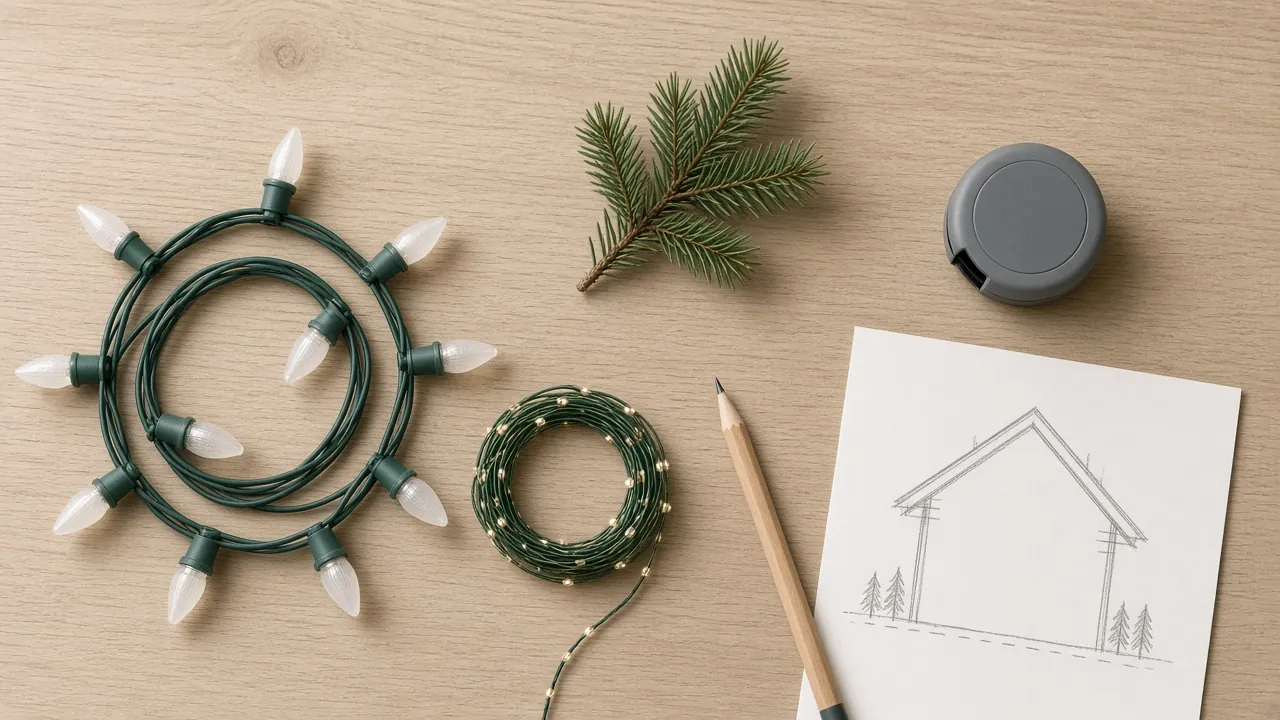
Buying lights is a lot more pleasant when you buy the right amount once. The two questions that come up most are how many lights go on a tree and how many feet you need for a roofline, so we built a simple calculator for both.
The numbers below are planning estimates based on common decorating rules of thumb, not exact science. Light preferences vary a lot: some people love a soft scattering, others want a tree you can see from space. Use the calculator as a starting point, then adjust to taste. Buying one extra strand is a smart habit.
Tree lights calculator
The most common guideline is about 100 mini lights per foot of tree height for a classic look. People who like a brighter tree go to 150 or even 200 per foot. Wider, fuller trees take more than slim ones.
Roofline calculator
For a roofline, you need the total length you'll cover plus some extra for the run back to the outlet and any gaps between sections. Bulb count depends on spacing: 12 inches is a common choice for C9s on a roofline, and closer spacing looks fuller.
Worked examples
A 7.5-foot full tree
At about 100 lights per foot, that's around 750 lights, which rounds to eight strands of 100. For a brighter look at 150 per foot, plan on about 1,150 lights, or twelve strands of 100.
A 6-foot slim tree
A slim tree has less surface to cover. Our calculator scales it to about three-quarters of a full tree: roughly 450 lights for a classic look.
A ranch-style roofline
Say the front eave is 60 feet with a 10-foot run to the outlet. Add a little for corners and you're at about 74 feet of lights, which is three 25-foot strands. At 12-inch spacing, the eave itself takes about 60 bulbs.
A two-story front with a gable
Add the eaves plus both sloped sides of the gable. A 30-foot-wide gable that rises 10 feet has two slopes of roughly 18 feet each, so that peak alone takes about 36 feet of lights.
How to measure a roofline
You don't need to get on the roof to measure it. A few ways that work from the ground:
- Measure along the ground. For horizontal eaves, walk a tape measure along the foundation under the gutter line. The length is the same.
- Peaks and gables. Measure the base width of the gable and its height, then use the Pythagorean theorem for each sloped side: the square root of (half the width squared plus the height squared). Or simply estimate each slope as a bit longer than the height.
- Break it into sections. Sketch the front of the house, label each straight run, and add them up. This also shows you where each strand starts and ends.
- Mark the outlet. Note where power is, and add the distance from the outlet to the start of each run.
Lighting a tree well
Work branch by branch
For the fullest look, wrap lights along each main branch, out toward the tip and back toward the trunk, rather than circling the outside. It takes longer and the tree glows from within.
Start at the bottom, near the outlet
Plug the first strand in before you start, so you can see gaps as you go. Work up from the base.
Mix in a few larger bulbs
A strand of C6 or C7 bulbs tucked deep in the branches adds depth behind the minis.
Outdoor trees and shrubs
For shrubs, net lights cover evenly in minutes. For outdoor trees, wrap the trunk tightly and the main limbs more loosely. Bare trunks wrapped in warm white look elegant all winter.
Railings, garland, and windows
Railings
Measure the railing length. If you'll lay lights straight along the top, buy that length plus the run to the outlet. If you'll spiral them around the rail, plan on roughly one and a half to two times the length, depending on how tight the wrap is. Test a few feet first to see how much one wrap uses.
Garland
For lighting a plain garland yourself, wrap a mini strand loosely along it. A strand about the same length as the garland gives a gentle glow; one and a half to two times the length looks fuller.
Windows and doors
Measure the full perimeter: two sides plus the top (and the bottom, if you're outlining the whole frame). C7 or mini lights suit window frames, and C9s look best kept to the roofline so the windows read as a lighter layer.
Plan your outlets- Check each package for the maximum number of strands you can connect end to end.
- LEDs use far less power than incandescent, so you can usually connect many more strands on one run.
- Plug outdoor displays into GFCI-protected outdoor outlets, and use outdoor-rated cords and timers.
- A timer handles the on-and-off for you every night.
For bulb types and color temperature, see our outdoor Christmas lights comparison. Shopping for a pre-lit tree instead? Our artificial tree guide covers light counts.
Lights calculator questions
Should I round up or down?
Round up. An extra strand fills a sparse spot, replaces one that stops working mid-season, and costs much less than a December trip back to the store when shelves are thin.
What about shrubs?
Net lights are sized by area, often listed in feet by feet, so measure the width and height of each shrub and match the net to it. For mini lights on a shrub, drape one strand evenly, step back to the street, and add more until it looks as full as you like.
Do pre-lit trees need extra lights?
Many people love their pre-lit tree exactly as it comes. If you want more glow, add a strand or two wrapped deep near the trunk, which brightens the tree from within without changing the look of the existing lights.
How do I count lights on a tree that's already decorated?
Check the box or product listing for the light count, or count strands and multiply by lights per strand. Then compare it to the calculator to see if you want to add more.
Lights to consider
As an Amazon Associate I earn from qualifying purchases. How our links work.
How we chose: A short list from our outdoor lights comparison: one long-run mini strand, one C9 set, a C9 stringer for custom lengths, and a timer. All currently sold by the linked retailer, chosen from specs and listings, not hands-on testing.
Budget · VEVOR
VEVOR 200-LED Connectable String Lights, 76 ft, Warm White
Long-run warm white minis for trees, railings, and shrubs.
What we like
- 76 ft per strand covers a lot of ground
- Connectable for longer runs
Good to know
- Check the max connectable strands on the box before linking many together
Price and stock set by VEVOR. Link checked Nov 2, 2026.
Budget · Christmas Light Source
Christmas Light Source 25-Light C9 Pure White LED Set, 8" Spacing
Big classic C9 bulbs in a crisp white for rooflines and walkways.
What we like
- C9 bulbs read clearly from the street
- Green wire blends into gutters and shrubs
Good to know
- Pure white is a cooler tone, so pick warm white if you want a candlelit feel
Price and stock set by Christmas Light Source. Link checked Nov 2, 2026.
Mid-range · 1000Bulbs
100 ft C9 Christmas Light Stringer, 100 Sockets (bulbs sold separately)
The pro-style route: a long socket cord plus the bulbs you choose.
What we like
- One long run with fewer plug connections
- Swap bulb colors or styles any year
Good to know
- Bulbs are a separate purchase, so budget for 100 of them
Price and stock set by 1000Bulbs. Link checked Nov 2, 2026.
Budget · 1000Bulbs
Tork 24-Hour Mechanical Plug-In Timer (indoor)
Turns the tree on at dusk and off at bedtime without a thought.
What we like
- No app or Wi-Fi needed
- Simple pin-style schedule
Good to know
- Rated for indoor use, so use an outdoor-rated timer for porch and roofline
Price and stock set by 1000Bulbs. Link checked Nov 2, 2026.
More planning help for the season is on our Christmas hub.